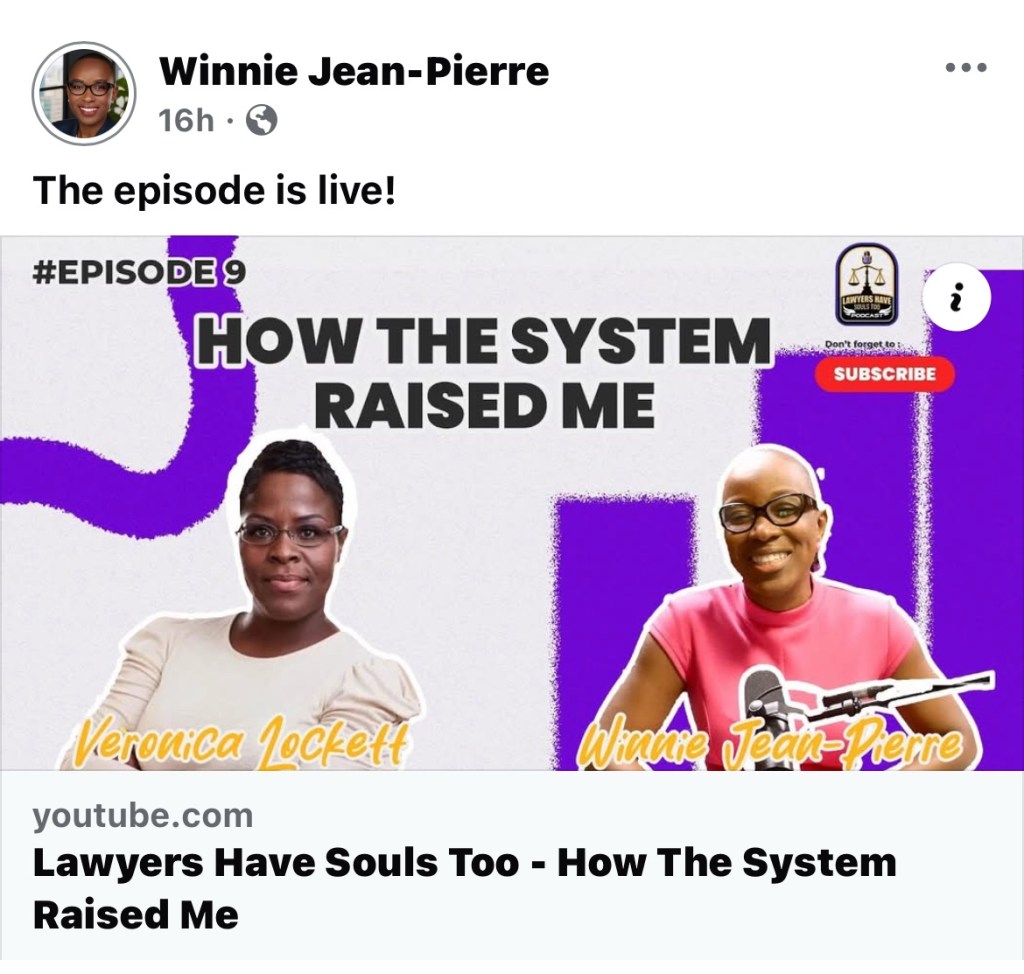
By Veronica Lockett
There are moments in life when someone hands you a microphone, but what they are really offering is a mirror. It is a moment to see the pieces of yourself you survived, healed, carried, and transformed. That was my experience on the Lawyers Have Soul podcast.
When I speak publicly about my journey, I do not speak from the mountaintop. I do not have a mountaintop.
I speak from the middle. The in between spaces where trauma, faith, survival, and purpose meet. The spaces where you are still healing, still learning, still growing, still hurting, still becoming. The spaces where life shaped you in ways you did not ask for but learned to navigate anyway.
This interview pulled me back into those rooms.
The First Memory: Pig Feet, Chitlins, and Silence
When they asked about my earliest memory, I laughed to myself because the truth was not pretty or poetic. It was pig feet.
That is what came to mind first. Not trauma. Not chaos. Pig feet. The food that told me I was in someone else’s home and that I did not belong.
I remember the smell.
I remember the feeling.
I remember being a child trying to figure out how to be grateful for whatever was placed in front of me, even when it made me want to cry.
Foster care teaches you to appreciate anything given to you, even things that are not meant for you. That lesson follows you long into adulthood.
The System Teaches You Not to Expect Stability
People assume the hardest part of foster care is leaving your home. They do not understand the deeper pain. The pain of learning that stability is a luxury.
Moving from place to place shapes your sense of trust. Being treated like a number shapes your identity. Learning to survive shapes your relationships.
You learn not to trust.
You learn not to depend on anyone.
You learn to build walls long before anyone has a chance to hurt you.
Even now, at 44, part of me still wants to belong to something. And part of me still wonders if I ever truly will.
My Mother and I: Two Sentences and One Prison
Some parts of my story sound like fiction, even to me.
Like the last six months of my prison sentence, when the system placed my mother and me on the same unit.
Two generations of pain in one dorm.
Two histories.
Two wounds that never had a chance to heal.
Two women who never learned each other outside of trauma.
She is gone now, but that time forced me to face everything I had tried to outrun. Anger. Abandonment. Grief. And the version of myself shaped by survival instead of safety.
For the first time, I had to sit with my own reflection.
And it changed me.
Domestic Violence, Mislabeling, and Becoming the Aggressor
In the interview, I talked about my domestic violence experience. At the time, the system did not recognize me as a victim.
I was young.
I was scared.
I did not know better.
And instead of being seen as someone who needed protection, I was labeled the aggressor.
With what I know today, I understand that the system would view me differently now. But back then, Black women were not granted vulnerability. We were not granted softness. We were not granted protection.
We were expected to endure.
And many of us still are.
Prison Changed Me Through Reflection, Not Punishment
People assume prison hardened me.
The truth is prison forced me to be still.
Still enough to see my own cycles.
Still enough to understand my patterns.
Still enough to ask myself the hard questions.
Why was I still writing my abuser? Why was I still trying to go back?
When I finally put his name on the I 60 and cut off contact, something shifted.
Not instantly.
But honestly.
That is when healing began.
Social Work, Lived Experience, and Seeing People Clearly
After prison, I did not know where my life was going.
I only knew I wanted to help people like me. People without a voice or people who did not know how to use theirs.
Social work gave me language.
It gave me purpose.
It gave me a way to turn survival into service.
But it also showed me the limits of the system.
How professionals lacked humanity.
How parents were judged for conditions created by poverty, not by choice.
How empathy was a skill and not a standard.
And that is when I realized something powerful.
Compassion alone cannot fix a system.
You need power.
Becoming an Attorney: Turning Pain Into Power
I went to law school because I was tired of watching attorneys walk into court, talk for two or three minutes, and walk out with recommendations that shaped an entire family’s life.
I kept thinking, if this is all they have to do, then I can do it too.
I knew I had something law school could not teach.
Life taught me.
Foster care taught me.
Prison taught me.
Motherhood taught me.
Homelessness taught me.
Healing taught me.
And now, through Veronica Lockett Law, PLLC, I advocate with a perspective most lawyers will never have.
Lived experience is my expertise.
Writing From the Middle
During the interview, I said something that has guided my entire writing journey.
I do not write from the mountaintop.
I write from the middle.
Because the middle is where most people live.
Right in the thick of it.
Still processing.
Still hurting.
Still becoming.
Still trying to understand themselves while carrying what they survived.
This podcast reminded me why I started Veronica Unfiltered.
The page does not judge you.
The page lets you breathe.
The page lets you tell the truth.
And today, this is my truth.
I was raised by a system that was not designed to protect me.
I became a woman who protects others anyway.
I turned survival into a calling.
I turned pain into purpose.
I turned silence into testimony.
And I will continue to tell the truth. For the child I was. For the women I advocate for. For anyone who needs to know they are not alone.
Veronica Out. . .
 Veronica Unfiltered
Meet me at the middle and leave a Reply